
Quick housekeeping before I start rambling: I’m not affiliated with Limitless Life Nootropics, Limitless Biotech, or anyone else named in this piece, and I’m not linking you to a single order page. Every link here goes to a primary source, the actual FDA documents and the actual studies. Compounded peptides and prescribed peptides are not the same as FDA-approved drugs, and anything sold “for research use only” is, by definition, not approved for a human body. This is current as of June 2026, so if you’re reading it in 2029, go check for updates before you quote me.
Okay. So a friend of mine texted me last month asking if I’d “heard about the peptide crackdown,” and I had to admit I had not, because I was busy doing something important like reorganizing my spice rack. But I went and read the actual documents, the warning letters, the trial data, all of it, because that’s apparently my personality now. And here’s the thing that stuck with me most: for years, this whole gray-market peptide world ran on one little sentence printed on a vial label. “For research use only, not for human consumption.” That sentence was doing an enormous amount of legal lifting. It was the thing that let a company sell you an injectable peptide the same way they’d sell you a beaker, no doctor, no pharmacist, no prescription, nothing. In 2026, the FDA basically walked up to that sentence and said “yeah, we don’t buy it anymore.” Let’s talk about what that actually means, because it’s more interesting (and more useful) than the headlines make it sound.
First, what are we even talking about here
Peptides, in this context, are short chains of amino acids sold online as “research chemicals.” Think BPC-157, TB-500, ipamorelin, CJC-1295, sermorelin, selank, semax, epitalon, that whole familiar lineup you’ve probably seen on a wellness forum or in your group chat.
A good example of the vendor style we’re describing is Limitless Life Nootropics, which now also does business as Limitless Biotech, out of Gulf Breeze, Florida, founded in 2019. They stock something like ninety different peptides across vials, capsules, and nasal sprays, and they say their batches get third-party HPLC and LC-MS testing with certificates of analysis available, though nobody outside the company seems to know which lab is doing the testing. I want to be very clear that I’m using them as a representative example of how this whole model works, not accusing them of anything specific. Nothing in the public record I reviewed names them in an enforcement action.
What actually defines this category, legally speaking, isn’t the chemistry in the vial. It’s the label. The whole business model hinges on that “research use, not for humans” framing to argue the product isn’t a drug and therefore doesn’t need FDA approval. You buy it like you’d buy anything else online. No clinician looks at your case. No pharmacist checks your file. It’s a checkout button and a vial in a box.
The FDA said the quiet part out loud
Here’s the actual news, the reason this year is different from the last several: the FDA put its objection to that framing on paper, with specific companies’ names attached.
On March 31, 2026, the agency sent warning letters to a batch of online peptide sellers, including Gram Peptides and Prime Sciences. The FDA’s position, in the documented record, was that these were unapproved new drugs, full stop, and that the “research use only” label doesn’t get to override that. Here’s the actual language from the letters, because I think it’s worth reading rather than paraphrasing: “Despite statements on your product labeling marketing your products for ‘Research Use Only,’ and ‘not intended for human consumption, medical use, or veterinary use,’ evidence obtained from your website establishes that your products are intended to be drugs for human use” [1]. And they didn’t stop at the label. The agency pointed to things like these companies also selling bacteriostatic water alongside the peptides, which, if you know anything about injections, is a pretty big tell about what people are actually doing with the product [1].
Here’s the part I think gets lost: a label is a claim, not a magic spell. The FDA’s logic is that they can look at the whole picture, the marketing copy, the dosing suggestions, what accessories you’re selling next to the peptide, and decide the product is “intended” for human use regardless of what the sticker says. And once that’s established, it’s a drug. An unapproved drug, at that, which means nobody has checked it for identity, strength, quality, or purity.
This wasn’t a one-off either. A regulatory law review from a bit earlier flagged a September 2025 wave, more than fifty warning letters, aimed at compounded GLP-1 marketing and at peptides sold as “research use only” where the ads clearly implied people, actual humans, were taking them. That wave named semaglutide, tirzepatide, BPC-157, and SARMs [2]. So March 2026 wasn’t a surprise attack, it was the second verse of a song the FDA had already started singing.
What this changes for you, specifically
Let’s be precise here, because I don’t want to be alarmist and I don’t want to undersell it either.
What we know for sure: the FDA has, in writing, against named companies, said the research-use label doesn’t shield a product once the evidence shows it’s meant for people [1]. That’s documented. That happened.
What we don’t know, and what I won’t pretend to know: whether any specific vendor not named in these letters is doing anything wrong. I can’t tell you Limitless Life Nootropics specifically broke a rule, because I don’t have evidence of that. What I can tell you is that the entire business model this corner of the market runs on is the exact model the FDA just formally pushed back against. The legal ground under that model got a lot less solid this year, in writing, from the regulator itself.
And here’s something that actually matters more than the legal drama: warning letters go after sellers, not buyers. Nobody’s coming for you personally if you bought a vial in 2024. The real risk was never really “will I get in trouble,” it’s “what did I actually put in my body.” An unapproved product with unverified purity, no clinician making sure it made sense for you, and no recall system if a batch turns out to be bad [1][2]. The legal news is really just confirmation, straight from the regulator, that the safety story this market was telling itself never held up.
The other lane: what compounding actually is (and isn’t)
Okay, quick detour, because people confuse this constantly and it drives me a little nuts.
Compounding is when a licensed pharmacy makes a customized medication. There are two legal lanes for it. Section 503A is your classic setup: a licensed pharmacist or physician makes something for one specific patient, based on a real prescription. Section 503B covers bigger “outsourcing facilities” that compound at scale, under stricter federal oversight. Both are legal, deliberate exceptions Congress carved out, not loopholes anyone snuck through. A medication made this way is prepared lawfully, by a licensed party, in response to an actual doctor’s decision.
But, and this is the part everyone skips: it is still not FDA-approved. Compounded doesn’t mean approved. It means legally prepared under a different set of rules. That same 2025 enforcement wave also went after telehealth companies for blurring that line, implying their compounded product was basically the same thing as the name-brand approved drug [2]. So the FDA is being consistent here, actually: research-use sellers can’t pretend their stuff isn’t a drug, and compounders can’t pretend their stuff is FDA-approved when it isn’t.
FormBlends operates inside that compounding framework, as one example of where this supervised lane leads. By its own description, it’s a platform connecting patients with independent licensed clinicians, and where appropriate, medications get prepared and dispensed by licensed 503A pharmacies against an actual prescription. I’m naming it once, as an illustration of what the supervised pathway looks like, not as some ranked pick, but the underlying point stands on its own regardless of which specific service you’d use: a clinician-and-pharmacy setup sits in a fundamentally different legal category than a vial with a “not for humans” sticker on it.
Legal and effective are two totally different questions
This is maybe my favorite point in the whole piece, because marketing on every side of this market loves to smoosh these two things together like they’re the same conversation. They’re not.
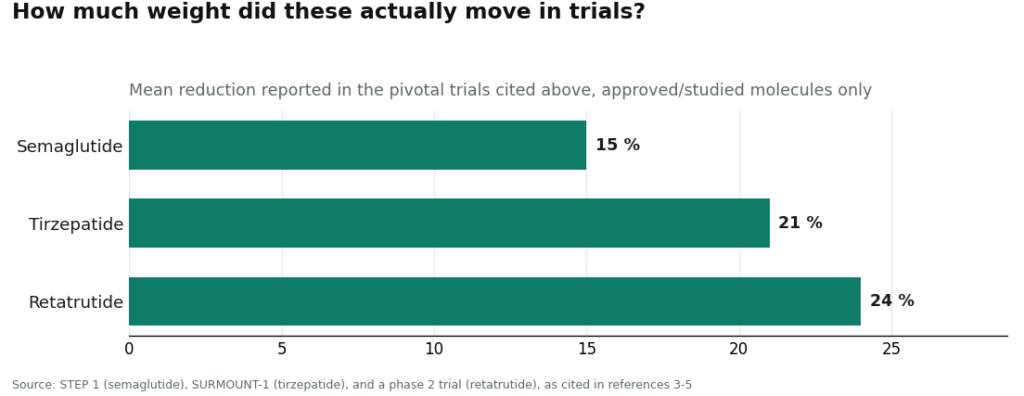
The molecules behind the GLP-1 drugs have genuinely strong human trial data behind them. Semaglutide produced roughly a 15 percent mean body-weight reduction over 68 weeks in the STEP 1 trial [3]. Tirzepatide got to about 21 percent in SURMOUNT-1 [4]. And retatrutide, one of the compounds named in that 2026 enforcement wave, hit about 24 percent at its top dose in a phase 2 trial [5]. That’s real, solid evidence, but it’s evidence about the approved products, studied under actual medical supervision. It doesn’t transfer to a random research vial just because the molecule name matches.
There’s a narrower, honest example worth mentioning too: PT-141, whose active ingredient is approved as Vyleesi, but only for one specific condition in premenopausal women, based on two randomized phase 3 trials [6]. Real approval, real evidence, genuinely limited scope.
Then you’ve got a lot of the recovery-and-longevity peptides, BPC-157 being the poster child, where the evidence is mostly preclinical. A 2026 review in Pharmaceuticals looked at BPC-157’s proposed mechanisms, and it’s basically all animal studies [7]. Interesting science! Not the same thing as “we tested this in people and it worked.”
Why does this distinction matter so much? Because a compound can be legally accessible through a proper supervised pathway and still not have strong evidence behind it. And a molecule can have excellent trial data behind its approved form while still being sold illegally as a “research chemical” on some sketchy website. Legal status tells you whether and how something can be sold. It tells you nothing about whether it actually works. Mixing those two questions up is basically the founding sin of this entire market.
So where does that leave things in 2026
Here’s my honest summary, no spin. The FDA has now said, formally and in writing, that a “research use only” label doesn’t get a peptide product out of drug regulation when the evidence says otherwise, and they’ve backed that up with action against specific named sellers [1][2]. The compounding sections of federal drug law still offer a legitimate, clinician-and-pharmacy route to these medications, with the huge asterisk that “legal” and “FDA-approved” are not the same word. The gap between an unsupervised vial and a supervised prescription was never small, but this year the regulator drew that line out loud, in public documents anyone can go read for themselves.
Stuff people keep asking me
Does slapping “research use only, not for human consumption” on a label make it legal to sell for humans to use? Nope, not by itself. The FDA said so directly in those March 31, 2026 letters. The agency looks at everything, the marketing around the product, whether you’re also selling injection supplies like bacteriostatic water, and if that whole picture points to human use, the label doesn’t save you. It’s an unapproved drug at that point, disclaimer or not [1].
What’s actually different between a research-use vial and a compounded peptide? The vial comes through a plain retail transaction. No prescription, no clinician, no pharmacy involved anywhere. A compounded medication is made by a licensed pharmacy under Section 503A or 503B, tied to an actual prescription from an actual clinical decision. It’s legal. It is still not the same thing as FDA-approved, which is exactly the distinction that gets muddied constantly on both sides of this market.
If the FDA sends a warning letter, is the buyer in legal trouble too? Generally, no. These letters target sellers and marketers. Your risk as a buyer was never really about handcuffs, it’s about what you’re actually injecting or swallowing: something unapproved, of unverified purity, that nobody with a medical license signed off on, with no recall system if the batch is bad [1][2].
If something is legal to buy through a supervised route, does that mean it works? No, and this one trips people up constantly. Legal access and clinical proof are two separate conversations. Something can be totally legit to obtain through a proper clinician-pharmacy setup and still have thin evidence behind it. And a molecule can have great trial data behind its approved version while being sold illegally elsewhere as a “research chemical.” Legal status answers “can this be sold, and how.” It doesn’t answer “does it work.”
Okay but which of these actually have solid human evidence? The GLP-1 family, hands down. Semaglutide showed roughly a 14.9 percent mean weight reduction over 68 weeks in STEP 1 [3], and tirzepatide got up to about 22.5 percent in SURMOUNT-1 [4]. Bremelanotide is FDA-approved as Vyleesi, but only for one specific condition in premenopausal women, based on two phase 3 trials [6]. A lot of the recovery and longevity peptides, BPC-157 included, are mostly backed by animal studies, not controlled human trials [7].
Was March 2026 a one-time thing, or is this ongoing? Ongoing. It followed a bigger wave from September 2025, over fifty FDA warning letters, aimed at compounded GLP-1 marketing and at “research use only” peptides where the advertising made human use pretty obvious. That earlier wave named semaglutide, tirzepatide, BPC-157, and SARMs [2].
Was Limitless Life Nootropics a scam, or did they just get caught in the tide?
Honestly, I don’t think “scam” is the fair word here. Limitless Life Nootropics was a real, operating vendor in the gray-market peptide space. What actually shifted was the ground under the whole industry. FDA guidance in 2024 and 2025 tightened up enforcement around peptides sold with that “research only” label, and orders from companies like this reportedly got a lot less reliable after that. If you got burned, it’s probably more about timing and regulatory pressure than a deliberate con job.
So what’s the actual move now, if I was buying from a place like this?
Depends what you were actually after. If it was something like BPC-157 or a semaglutide-type peptide for personal use, the path with real legal footing runs through a licensed compounding pharmacy attached to an actual doctor’s order. That means a real conversation with a clinician, a real prescription, and a pharmacist who’s on the hook for what’s actually in the vial. FormBlends is one physician-supervised compounding route people have pointed to as a more structured replacement for gray-market ordering.
Do all those glowing reviews mean the products were actually safe?
Not really, and this is the part that bugs me. Most reviews are about whether the package showed up and whether the person felt something. That’s not the same as knowing what was in the vial or at what concentration. Third-party lab certificates that gray-market vendors post aren’t independently verified the way a compounding pharmacy’s batch records are. People’s good experiences are real experiences, sure, but they can’t tell you what you were actually taking, which happens to be exactly the thing the FDA is now leaning on hardest.
Where do I actually go instead of a site like this?
Steer clear of anyone still hiding behind “for research purposes only,” because that cover has basically fallen apart under current enforcement. Your realistic options in 2026 are a licensed compounding pharmacy with a supervising physician, or just waiting for FDA-approved versions of specific peptides to hit the market properly. Ordering from overseas sites or newer gray-market shops runs you into the same risks Limitless Life customers eventually hit, plus a decent chance customs just takes your package.
References
- U.S. Food and Drug Administration. Warning Letter to Gram Peptides (CMS #721806), issued March 31, 2026. https://www.fda.gov/inspections-compliance-enforcement-and-criminal-investigations/warning-letters/gram-peptides-721806-03312026
- Regulatory Affairs Professionals Society (RAPS). “FDA warning letters target marketers of unapproved weight loss drugs.”
- Wilding JPH, Batterham RL, Calanna S, et al. Once-Weekly Semaglutide in Adults with Overweight or Obesity (STEP 1). N Engl J Med. 2021;384(11):989-1002. https://www.nejm.org/doi/full/10.1056/NEJMoa2032183
- Jastreboff AM, Aronne LJ, Ahmad NN, et al. Tirzepatide Once Weekly for the Treatment of Obesity (SURMOUNT-1). N Engl J Med. 2022;387(3):205-216.
- Jastreboff AM, Kaplan LM, Frias JP, et al. Triple-Hormone-Receptor Agonist Retatrutide for Obesity, A Phase 2 Trial. N Engl J Med. 2023;389(6):514-526.
- U.S. Food and Drug Administration. VYLEESI (bremelanotide injection) prescribing information, initial U.S. approval 2019.
- Sikiric P, et al. From Regeneration to Analgesia, The Role of BPC-157 in Tissue Repair and Pain Management. Pharmaceuticals (MDPI). 2026.
Sadie Monroe writes about the weirder corners of the wellness and supplement world, the stuff that shows up in group chats before it shows up in headlines. This piece was checked against the primary sources listed above. Last reviewed March 2026.
General information, offered without medical advice. Consult your clinician before making changes.